
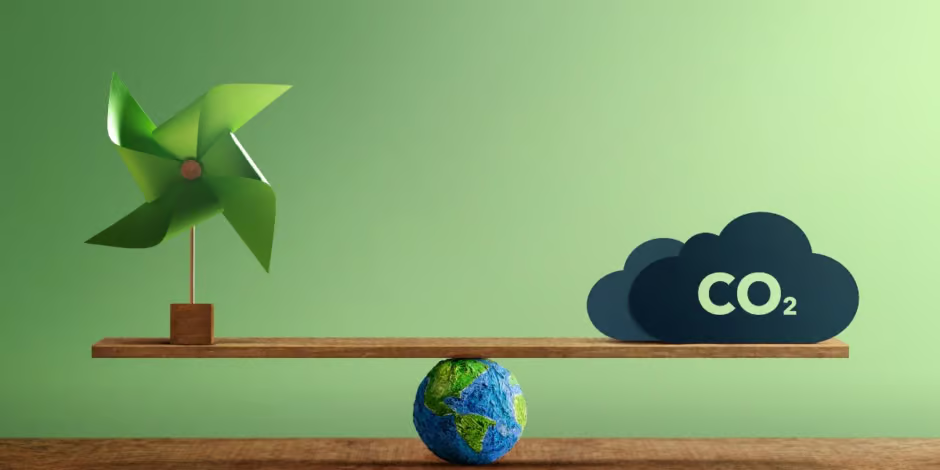
Pakistan stands at a critical intersection of climate risk and economic opportunity. As one of the countries most affected by climate-driven disasters, it faces mounting pressure to decarbonise. However, simultaneously, it holds an untapped opportunity to turn emissions reductions into revenue. According to a recent study by Transparency International Pakistan, Pakistan has the potential to generate 40 to 75 million tons of carbon credits annually, translating into a possible revenue stream of US $400 million to US $2.25 billion each year. Business Recorder+2ProPakistani+2
In other words, through a properly organised carbon-credit market, Pakistan could not only reduce its greenhouse gas emissions but also unlock a substantial income stream—in effect, monetising its mitigation efforts rather than simply bearing the cost of climate change.
How the Carbon Credit Market Works — and Pakistan’s Edge
To understand this opportunity, it helps to quickly review how carbon markets work. Essentially, a carbon credit represents one ton of CO₂ (or equivalent) either avoided or removed from the atmosphere. Firms that are high emitters can buy these credits from projects that reduce or sequester emissions. In turn, the credits become tradable assets in voluntary or compliance markets.
Pakistan’s edge lies in several factors:
- It has vast mitigation potential across forests, agriculture, waste, energy and coastal ecosystems (especially mangroves). cpdi-pakistan.org+1
- Its “marginal abatement cost” (the cost of reducing one ton of CO₂) is relatively low compared to many developed countries, making projects more economical. Dawn+1
- It is positioning itself early to tap into emerging markets under Paris Agreement Article 6 mechanisms, which allow international co-operation in carbon trading. IESR+1
Consequently, Pakistan is well-positioned to ride the global wave of carbon pricing while leveraging its natural and technical strengths.
The Numbers: Potential Value and What It Means
Let’s put the headline numbers into clearer context. The Transparency International report estimates:
- 40-75 Mt of carbon credits annually by addressing just 10-15% of Pakistan’s greenhouse gas emissions. ProPakistani+1
- At current voluntary market prices, that could equate to US $400 million to US $2.25 billion annually. Business Recorder
- Some studies suggest that by 2030, Pakistan might unlock US $2 billion to US $5 billion if the market is scaled and linked globally. carbon-pulse.com+1
What do these numbers mean? In short: a meaningful boost to Pakistan’s economy—particularly at a time when it is seeking new foreign-exchange earnings and sustainable investment-friendly sectors. Moreover, revenue from carbon trading could be reinvested into climate resilience, green jobs and sustainable infrastructure.
Opportunities: Where Pakistan Can Act Now
Fortunately, Pakistan already has some promising starting-points and sectors where carbon-credit projects can flourish:
- Mangrove & Coastal Ecosystems: Projects like the Delta Blue Carbon Project (Indus Delta) have shown the potential of “blue carbon” credits (carbon sequestered by coastal/marine ecosystems). cpdi-pakistan.org+1
- Renewable Energy & Efficiency: Expanding solar, wind and energy-efficiency initiatives can create carbon credits while reducing dependency on imported fuel. resourcesfuture.com+1
- Agriculture & Land Use Changes: Improved farming practices, afforestation, reforestation and sustainable land management can yield credits and create rural employment. nim.gov.pk+1
- Waste & Industrial Emissions: Capturing methane from waste, improving industrial processes and offering alternatives for cleaner production can feed into carbon-credit markets. resourcesfuture.com
By prioritising these sectors, Pakistan could build a diversified pipeline of carbon-credit generating projects, spreading risk and maximising impact.
Challenges: What’s Holding Pakistan Back?
However, the potential doesn’t guarantee success without addressing some significant barriers. Importantly:
- Governance & Integrity: The Transparency International report highlights gaps in transparency, monitoring, benefit-sharing and community participation. ProPakistani
- Technical Capacity: Pakistan currently lacks a consolidated national emissions baseline, comprehensive measurement-reporting-verification (MRV) systems, and a robust registry for carbon credits. Business Recorder+1
- Regulatory Framework: While policy guidelines are emerging, a fully operational law and regulatory architecture are still needed to support a credible market. resourcesfuture.com
- Global Market Access & Pricing: The ability to link to international markets (compliance markets, major buyers) and generate high-quality, high-value credits remains a challenge.
- Benefit-sharing & Local Communities: Ensuring that revenues trickle down—especially in rural or marginalised communities where many carbon-sequestering activities take place—is essential for social equity and sustainable buy-in. Business Recorder+1
If these issues are not addressed, the carbon-credit opportunity could fall short of its promise—or worst, encounter reputational risks that undermine investor confidence.
6. The Way Forward: How Pakistan Can Capitalise
So what steps should Pakistan take to turn this potential into reality? The following priorities stand out:
- Create a National Carbon Coordination Body: A single entity to coordinate federal and provincial roles, oversee registry creation, verify credits and monitor market integrity.
- Build Technical Infrastructure: Deploy MRV systems, establish baselines for emissions, train project developers, validators and verifiers.
- Ensure Transparent Governance: Develop clear rules for how credits are issued, how revenues are shared, how communities are engaged, and publish data.
- Develop Project Pipelines: Launch pilot projects in promising sectors (mangrove restoration, solar farms, sustainable agriculture) to create early success stories and demonstrate viability.
- Forge International Partnerships: Link to global carbon markets and buyers, align with international standards (e.g., Verra, Gold Standard) and leverage bilateral cooperation.
- Reinvest Revenues Strategically: Use a portion of revenue to strengthen climate resilience, create green jobs and support vulnerable communities.
By taking concrete action and coordinating across government, private sector and civil society, Pakistan can position itself not just as a carbon-credit seller but as a leader in the region’s emerging green economy.
In conclusion, Pakistan’s carbon-credit potential is real—and sizeable. With the right pieces in place, the country could generate over US $2 billion annually while advancing its climate goals. The logic is clear: turn emissions reductions from a cost-centre into an asset-class. If Pakistan moves decisively now, then this opportunity will not only help mitigate climate risk but also support sustainable economic growth for years to come.