In an important move for the extended reality (XR) ecosystem, Magic Leap announced a multi-year strategic hardware partnership with Google. According to Magic Leap’s May 30 2024 press release, the collaboration will combine Magic Leap’s optics and hardware manufacturing experience with Google’s technology platforms to bring new augmented reality (AR) solutions and experiences to market. Magic Leap+2AIT365+2
Meanwhile, Reuters reported that Google confirmed the deal and that it “adds to signals that Google may be plotting a return to the AR/VR market.” Reuters+1
Thus, this partnership marks a key step forward for both firms as they seek to shape the next wave of AR hardware.
2. What Each Company Brings to the Table
First, Magic Leap brings deep expertise in AR optics, waveguides and display systems. Their decade-plus work on lightweight, high‐fidelity AR devices positions them as a hardware specialist. Magic Leap+1
Second, Google contributes its broad software and platform strength—including developer ecosystems, device services, AI/ML capabilities, and potentially the Android XR operating system. CNBC+1
Consequently, the partnership appears intentionally structured: Magic Leap focuses on the hardware and optics stack, while Google supplies the platform, software layers and developer integration. For example, one analyst noted:
“Magic Leap’s leadership in optics and manufacturing with Google’s technologies … we can foster the future of the XR ecosystem with unique and innovative product offerings.” Computerworld+1
Therefore, the synergy of both firms could accelerate AR hardware readiness for consumer and enterprise markets.
3. Early Indicators: Prototype & Technical Focus
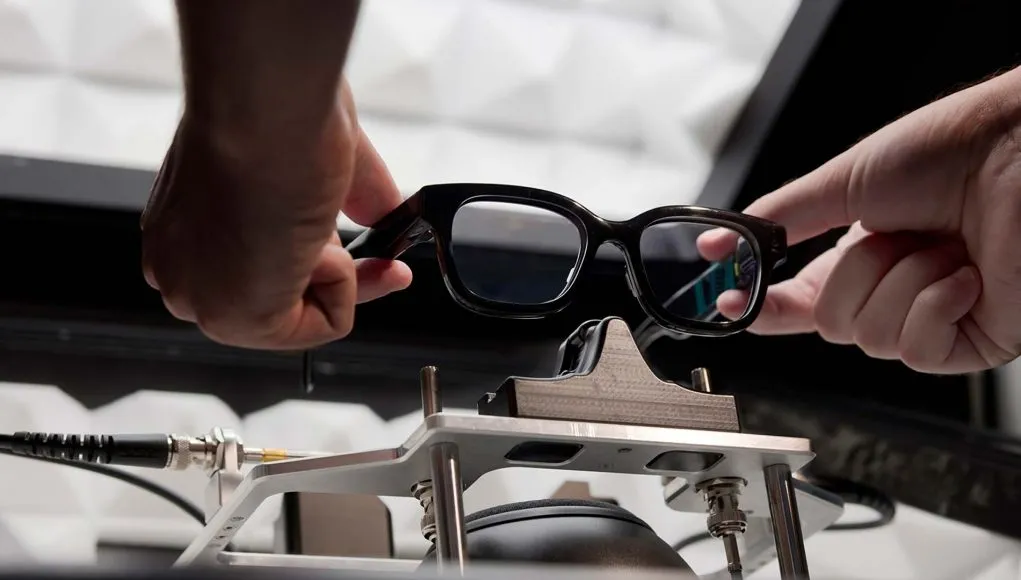
Interestingly, the companies have already showcased early signs of what they intend. Magic Leap recently revealed an Android XR smart glasses prototype built as a reference design for the Android XR ecosystem—where Magic Leap’s waveguides and optics are combined with Google’s microLED light engine. Yahoo Tech+1
Moreover, the prototype focuses on three key elements: comfort (wearability), visual quality (clarity, stability) and manufacturability (scale readiness). As Magic Leap notes:
“We’re at a turning point for AR glasses … combining our optics with Google’s microLED light engine to make all-day wearable AR more achievable.” Magic Leap+1
Thus, beyond just a “logo” partnership, this suggests tangible hardware development is underway.
4. Market Implications: Why This Matters
Firstly, the AR/VR hardware market is preparing for growth, with more emphasis on wearable smart glasses and untethered solutions rather than bulky headsets. This partnership positions both firms to capture that shift.
Secondly, by leveraging Magic Leap’s hardware maturity and Google’s platform presence, the two companies challenge other major players—such as Meta Platforms and Apple Inc.—in the XR hardware-software convergence race. The Cryptonomist+1
Thirdly, for enterprise use-cases (manufacturing, training, spatial computing), this alliance may yield strong outcomes—as Magic Leap has enterprise traction and Google broad reach in enterprise services. Hence, this partnership could accelerate AR adoption beyond niche.
Finally, a multi-year commitment signals long-term belief in the category rather than a one-off experiment. That stability may attract developers, accessories, and hardware ecosystem players.
5. Challenges and Considerations to Watch
Nevertheless, there are risks and caveats. For one, neither company has publicly committed to a specific consumer device release timeline or full specs. CNBC+1
Additionally, the AR hardware market has seen previous false starts—including Google’s earlier foray with Google Glass—so customer expectations, wearability, and price remain key hurdles. Computerworld
Moreover, manufacturing at scale with optics, waveguides, microLEDs and wearable comfort is hard. Magic Leap acknowledges the challenge: “display technologies that make all-day wearable AR more achievable” still must cross cost, battery, and usability thresholds. Yahoo Tech+1
Finally, product ecosystem matters: software, developer apps, accessories, and user experience will decide success—not just hardware partnership. Thus, while promising, the path to mainstream AR remains complex.
6. What to Expect Next: Roadmap Highlights
Going forward, we can anticipate a few key milestones:
- Prototype showcases and reference designs, likely via trade shows or developer conferences, pointing to the partner hardware. (Already glimpsed.)
- Developer kit or ecosystem support announcements where Google and Magic Leap enable third-party developers to build AR apps for new hardware.
- Potential enterprise-first launches—given Magic Leap’s strength in enterprise AR—before consumer rollout.
- More details on device specs: battery life, display size, field-of-view, microLED/optics innovations.
- Marketing messages around everyday wearability, comfort, and work use-cases (training, visualization, remote assistance).
In sum, this partnership is likely to evolve incrementally—but strategically—rather than instant blockbuster consumer product.
7. The Big Picture: What This Means for the AR Ecosystem
In the bigger picture, this partnership underscores that AR hardware is entering a maturation phase. Wearable AR is no longer hype—it’s hardware plus software integration plus ecosystem development.
Moreover, it signals that big platform players like Google view AR as a multi-year investment, not just side project. Meanwhile, specialist hardware firms like Magic Leap are repositioning—moving from standalone devices toward being ecosystem hardware partners.
Finally, for consumers and enterprises alike, the takeaway is that AR experiences may become more compelling, integrated and accessible in coming years. From training environments to everyday assistance to immersive media, AR may move from “cool demo” to “practical tool.”
In conclusion, the Google–Magic Leap multi-year hardware partnership offers one of the clearest signals yet that AR hardware is gearing up for its next chapter—one where optics, software, wearability and ecosystem converge.